
From the New York Times, May 29, 2021
Mr. Moore Gerety is a freelance reporter and audio producer.
It was a book of Buddhist parables that put Michael Rasmussen over the edge. In March 2017, Mr. Rasmussen was living near a naval base in Japan, six years into training as a Marine pilot, reading and experimenting with meditation.
One morning as he prepared for a supply flight to Hawaii, Mr. Rasmussen kept returning to the story he’d read in bed the night before in “Path of Compassion,” by Thich Nhat Hanh, in which the Buddha was out begging when he was nearly mugged by a notorious criminal. Instead of robbing the Buddha, the mugger confessed to a life of murder and mayhem and asked him for advice: “What good act could I possibly do?”
“Stop traveling the road of hatred and violence,” the Buddha said. “That would be the greatest act of all.”
Mr. Rasmussen got in his car to drive to the hangar, overwhelmed with what he called an “immense feeling of dread.” The story haunted him: “Am I on the road of hatred and violence?” he wondered. He decided then and there to leave the Marines.
But there was a catch: He still had six years left on his contract. In the weeks to come he would embark on the path to becoming a conscientious objector, a status that allows soldiers to leave the military early because of a change in their beliefs about war.
Some 2.7 million American service members have served in Iraq and Afghanistan since the start of our “forever wars” in 2001. Tens of thousands have gone AWOL. Countless others have finished out their service disenchanted and depressed, or turned to drugs and alcohol to ease re-entry into a society that would rather ignore war’s moral injuries, often losing their benefits in the process. After seeing the horrors of war and the contradictions of American foreign policy up close, many enlisted men and women are compelled to re-examine the ideals that first drew them to military service.
Very few soldiers, however, take the path that Mr. Rasmussen eventually did.
The military has been reluctant to publish official figures on conscientious objection. The most recent numbers available are from a Government Accountability Office report published in 2007, which found that on average fewer than 100 applicants a year from 2002 to 2006 — roughly half of them were approved. After that, the data is hard to find. The Center on Conscience and War advises only a subset of applicants for conscientious objector status, but as the wars in Afghanistan and Iraq dragged on, the caseload of the center doubled, its executive director, Maria Santelli, told me. She believes the actual number of annual applicants in recent years is closer to 200.
Though the act of conscientious objection arose historically in response to conscription — a mandatory draft — both Mr. Rasmussen’s story, and the vanishing scarcity of conscientious objectors overall today, raise an important question about the notion of our ostensibly all-volunteer military: How many American soldiers would become conscientious objectors if the process was more transparent, if they were more aware it was actually an option?
Military contracts require 18-year-olds with little knowledge of war to make commitments that sometimes last more than a decade. At the height of the Iraq war, the Pentagon offered signing bonuses as high as $50,000, and enacted a “stop loss” policy to extend service for tens of thousands of troops, prolonging their deployments just as their contracts were set to end.
Are these the hallmarks of a voluntary commitment? Allowing soldiers more leeway to vote with their feet would be one way to impose accountability on political leaders who have kept us at war longer than some recruits have been alive.
The rules governing conscientious objection present a narrow target: Soldiers can’t argue that they disagree with a particular war, or don’t want to fight under a certain general. The core requirement is opposition to “war in any form,” a belief that is firm, fixed and sincerely held. And that belief has to have been arrived at after your enlistment.
The first formal protections for conscientious objectors emerged with the military draft during the Civil War. During World War I, Mennonites, Quakers and members of other “peace churches” were allowed to work as army medics or cooks rather than soldiers. Those who objected altogether were subject to trial at military tribunals; thousands were imprisoned and many were tortured — shackled in solitary confinement, hung by their thumbs, or stripped of their clothes and sprayed with cold water if they declined to wear military uniforms.
It wasn’t until 1962 that the Department of Defense initiated an administrative process to allow conscientious objectors to leave the military after enlistment. By 1970, the Vietnam-era Supreme Court case, Welsh v. United States, allowed service members to claim conscientious objector status on secular grounds as well.
The most famous cases of conscientious objection were initially seen as illegitimate. In 1967, Muhammad Ali was convicted of draft evasion, fined $10,000 and sentenced to five years in prison; it took four years for his case to be overturned by the Supreme Court. Nearly a half-century later, Stephen Funk, a Marine Corps reservist and the first soldier to publicly claim conscientious objector status in the Iraq war, spent five months in military detention for failing to report to his unit in the lead-up to the invasion.
Today, requesting 1-O status, as becoming a conscientious objector is known in the military, kicks off a demanding process. Applicants outline their beliefs in essays, and an investigating officer, of higher rank but not in the chain of command, asks peers to weigh in on their character. There’s a psychiatric evaluation and an interview with a military chaplain. Mindful of the hazing and ridicule that plagued conscientious objectors during the Vietnam War, Michael Rasmussen decided that until he actually finished his application, he wouldn’t even tell his own family.
I met Mr. Rasmussen in 2018 through my father — a conscientious objector to the draft himself — who knew his parents. My father had filed his own request for conscientious objector status as a fervent Catholic during the Vietnam War, months before his 18th birthday.
By the time his number came up in the lottery, he’d lost his faith and led antiwar protests in college. He submitted a revised letter to the draft board as an earnest first-year law student, primed to debate whether the conflict in Vietnam constituted a just war. Opposition to unjust wars wasn’t considered a legitimate objection, but it hardly mattered: The man at the draft board knew my father’s father, and he seemed impressed that one of his references came from my dad’s future father-in-law, a bishop in the Episcopal Church.
I’ve never been able to imagine what my father might have been like if he’d gone to Vietnam. To me, his opposition to war seemed utterly fixed. So I was intrigued by my father’s description of Michael Rasmussen: someone who’d enlisted in the Marines, only to become a pacifist by reading philosophy.
When we met for breakfast, I worried Mr. Rasmussen wouldn’t want to share his story so publicly, but by the time I got home, he’d emailed me his entire 47-page conscientious objector file, which he’d submitted in 2017. On Marine Corps letterhead, Mr. Rasmussen’s short essays of conscience followed clinical prompts, and were bundled with character references and interviews with fellow officers.
“After countless sleepless nights and hours in thought, I am no longer able to reconcile my personal idea of what it means to live a good life with that of being part of an organization whose goal it is to end human life,” Mr. Rasmussen wrote. “Who are we to decide who must live and who must die?”
Michael Rasmussen signed up for the Marines while he was still in high school, out of a vague sense of duty and a burning desire to become a pilot, with a contract that gave him a free ride to college and firm commitments for the next 15 years of his life. His first extended military training came in 2011, between his junior and senior years at Villanova, at the Marine Corps officer candidate school in Quantico, Va.
Mr. Rasmussen, 30, has the slight, muscular build of a jockey or the long-distance runner he is. He’s direct and unfailingly polite, with a disarming manner that blends earnestness and sharp wit. When we met, he recalled officer candidate school as an exercise in willpower and sleep deprivation, often presented in the form of games. Recruits raced to pack and unpack their gear 10 times in a row. Told to “touch the fence, again,” they sprinted through muddy fields in the dark until they collapsed. Mr. Rasmussen enjoyed the camaraderie of shared exhaustion.
He returned to Quantico after college for the Basic School, where newly commissioned officers are trained, and he was pleased to find that the Marine Corps also prided itself on its intellectual tradition. The future defense secretary Jim Mattis, who was then the highest-ranking Marine, famously embodied the view of soldiers as “warrior-scholars.” When a commander suggested every Marine should read “Meditations” by the Roman emperor Marcus Aurelius, Mr. Rasmussen started right away.
Written as a journal while Marcus Aurelius was away on military campaigns, the core lesson of “Meditations” is of the power of self-reflection — “for the soul is dyed by the thoughts,” he wrote. Mr. Rasmussen had tried keeping a journal before, but he was amazed that the man at the head of an empire grappled with “all the same doubts we have” — the opinions of others, the soundness of our daily habits — and the insight inspired him to try again.
In his conscientious objector file, Mr. Rasmussen wrote that the Basic School amounted to six months of being “inundated with training on how to kill,” from hand-to-hand martial arts exercises to lectures on deploying violence against an entire platoon. But it was also the period when he began to think deeply about the commitments underlying his military service.
“As I thought more about the act of killing, I was able to explain it away,” Mr. Rasmussen told me — with the idea that being a pilot would keep him close to the cause but far from the action.
Still, when he read “On Killing,” a popular study of the psychology of violence by a retired Army lieutenant colonel, Dave Grossman, which figures on the Marine Corps’ list of required reading, Mr. Rasmussen zeroed in on Colonel Grossman’s argument that much of military training is essentially a means to short-circuit the innate human aversion to killing. For the first time, Mr. Rasmussen wondered not only if he could kill, but in what circumstances he should.
In his downtime during training, Mr. Rasmussen read Kant, Nietzsche, Thoreau and Emerson and gave up alcohol and meat; even as he remained far from combat, military service was drawing his ideals into focus.
After deploying with his squadron to Japan, Mr. Rasmussen returned to the Marine Corps’ foundational text, “Warfighting,” for the first time in five years, and found it impossible to read the book as it was meant to be read. “Warfighting” presented war not as love, hate, revenge and power, but friction, fluidity, uncertainty, disorder. An enemy is “a collection of targets to be engaged and destroyed systematically.”
In a journal he kept at the time, Mr. Rasmussen described his quandary as a “quarter life crisis.” He seemed to be leading parallel lives, each shaped by an ethic of discipline and self-improvement, yet completely at odds with one another. Always a loner, he was becoming more withdrawn from his fellow soldiers by the day. Philosophy seemed to follow him everywhere.
Watching the cartel thriller “Sicario” brought forth a dark meditation on just war: “Would I volunteer to die in Vietnam? No. Iraq? Hell, no. Korea? Possibly, but that is only because of the 20-20 hindsight” about the trajectory of North Korea. Mr. Rasmussen had finally made up his mind. “I no longer want to be in the military,” he wrote. “If they offered me an out tomorrow, I would take it.”
That day in March, Mr. Rasmussen drove to the hangar overtaken by a kind of existential nausea. For months, he’d been looking for a way to end his contract “without getting thrown in jail,” but there didn’t seem to be any good options. Mr. Rasmussen was an atheist raised in an atheist household; he had no idea there was a narrow allowance for secular objections of conscience. Then, as he awaited clearance for takeoff from Hawaii back to Japan, he hit upon the website of the Center on Conscience and War.
Despite his confidence in his decision, submitting the application seemed to leave Mr. Rasmussen disoriented. “I had just finished admitting to myself that everything I knew was wrong,” he told me.
In August, as his application worked its way up the chain of command, Mr. Rasmussen had a dream that he had run over a group of people that included Japanese civilians while taxiing in a C-130, then gotten out of the plane sobbing.
Finally, in October, the news came through: His application was approved.
The triggers that inspire soldiers to pursue conscientious objection are wide-ranging: Some become vegans for health reasons, then find that it affects their entire worldview. New parents gain a different view of the sanctity of life. Specific atrocities sometimes set off an outpouring of new applicants, as when a U.S. airstrike hit a Doctors Without Borders hospital in Afghanistan in 2015. Two soldiers who fought under Robert Bales, now serving life in prison for the massacre of 16 Afghan civilians in 2012, subsequently became conscientious objectors.
Recently, after seeing the heavy-handed federal response to protests over police brutality during the summer of 2020, a Navy officer called Ms. Santelli at the Center on Conscience and War, saying, “I’m not the guy with my knee on George Floyd’s neck, but I am the guy with his back turned on the scene with his hands in his pockets.”
Mr. Rasmussen believes the window for conscientious objection ought to be widened, and the burden of proof relaxed, so that our voluntary service could account for more modest shifts in perspective and circumstance. Before he submitted his application, he worried that it might bring ridicule from his peers. Instead, he said, many quietly approached him to talk about their own misgivings with the way the United States wields military power.
“If, tomorrow, we ended military contracts,” he told me, “I can only imagine the number of people that would voluntarily get out.”
A soldier’s willingness to give life for country is a profound act of trust; we should honor their commitment by trusting enlisted men and women to tell us they’ve changed their minds, and give them a way to act on it.
Rowan Moore Gerety is a freelance reporter and audio producer and the author of “Go Tell the Crocodiles: Chasing Prosperity in Mozambique.”
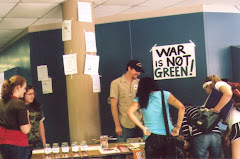
Excellent article posted today in Antiwar.com by Kate Connell and Fred Nadis about the work of Truth in Recruitment, a group like SOY in Santa Barbara, CA:
Counter-Recruitment in the Time of Covid
In 2016-17, the U.S. Army visited Santa Maria High School and nearby Pioneer Valley High School in California over 80 times. The Marines visited Ernest Righetti High School in Santa Maria over 60 times that year. One Santa Maria alumnus commented, “It’s as if they, the recruiters, are on staff.” A parent of a high school student at Pioneer Valley commented, "I consider recruiters on campus talking to 14 year olds as "grooming" young people to be more open to recruitment in their senior year. I want my daughter to have more access to college recruiters and for our schools to promote peace and nonviolent solutions to conflict."
This is a sample of what high schools, particularly in rural areas, experience nationwide, and the difficulty of confronting the presence of military recruiters on campus. While our nonprofit counter-recruitment group, Truth in Recruitment, based in Santa Barbara, California, views such military access as beyond excessive, as far as the military is concerned, now that the pandemic has closed campuses, those were the good old days. The Air Force’s Recruiting Service Commander, Maj. Gen. Edward Thomas Jr., commented to a journalist at Military.com, that the Covid-19 pandemic and high school shutdowns nationwide have made recruiting more difficult than previously.
Thomas stated that in-person recruiting at high schools was the highest yield way to recruit teenagers. “Studies that we’ve done show that, with face-to-face recruiting, when somebody is actually able to talk to a living, breathing, sharp Air Force [noncommissioned officer] out there, we can convert what we call leads to recruits at about an 8:1 ratio,” he said. “When we do this virtually and digitally, it’s about a 30:1 ratio.” With closed recruiting stations, no sporting events to sponsor or appear at, no hallways to walk, no coaches and teachers to groom, no high schools to show up at with trailers loaded with militarized video games, recruiters have shifted to social media to find likely students.
Yet the school shutdowns, combined with the economic uncertainty during the pandemic, have only made vulnerable populations more likely to enlist. The military also is aware of this. An AP reporter noted in June that in periods of high unemployment, the military becomes a more enticing option to teens from impoverished families.
This is apparent from our work. Truth in Recruitment has been working to reduce recruiter access to students in Santa Maria high schools where the demographics on some campuses are 85% Latinx students, many from immigrant farmworkers working in the fields. Nevertheless, the Santa Maria Joint Union High School District (SMJUHSD) was pleased to report in June 2020 that sixty students from all the area high schools had decided to enlist.
As a group dedicated to regulating the presence of military recruiters on campuses, and their access to students’ private information, we are seeing the consequences of both the pandemic and recruiters’ aggressive social media campaigns. Under the No Child Left Behind Act (NCLBA) of 2001, high schools that receive federal funds must allow recruiters to have the same access to students as employers and colleges. This law is often cited when school districts say that they cannot regulate recruiter access to their students and schools. But the key word in the law, which shows what is possible, is the word "same." As long as school policies apply the same regulations to all types of recruiters, districts can implement policies that regulate recruiter access. Many school districts across the country have passed policies regulating recruiter access, including Austin, Texas, Oakland, California, the San Diego Unified School District, and the Santa Barbara Unified School District, where Truth in Recruitment is based.
According to federal law, while districts are required to provide student names, addresses, and parents’ phone number, families have the right to "opt out" to prevent schools from releasing to the military further information about their children. However, now that teens have their own phones, recruiters have direct access to them – following them on social media, texting and emailing them privately – and have access to their friends in the process. Because of this, parental oversight is circumvented and a family’s privacy rights are ignored. Recruiters not only gain access to student’s through their phones, but through ‘surveys’ and sign up sheets, where they ask questions such as "citizenship status?" and other confidential information.
Recruiters online tactics can be dubious. For one example, The Nation reported that on July 15, 2020,the Army’s Esports team on Twitch advertised a fake giveaway foran Xbox Elite Series 2 controller, valued at more than $200.When clicked, animated giveaway advertisementsin the Army’s Twitch stream chat boxes led users to a recruiting web form with no mention of any giveaway.
Recent events reveal that building our military forces does not strengthen our country’s security. The COVID-19 pandemic has shown that the biggest threats to our nation cannot be stopped with military methods. It has also shown the risks that troops face from working and living close together, making them vulnerable to this deadly disease. In WW1, more troops died from disease than in combat.
The police killings of unarmed black people have also shown the ineffectiveness of force to ensure the safety of our communities. A young black woman on the news testified that she had considered joining the police force but changed her mind after seeing the systemic abuse of police departments, both in the killing of George Floyd and the way police brutalized peaceful protesters. Even more pointedly, the death of US Army SPC Vanessa Guillen, murdered by a fellow soldier at Ford Hood in Texas, after first being sexually harassed by an officer, indicates the unstated dangers that recruits can face.
How can those of us who are opposed to the current militarization of society in general and high schools in particular curtail the military’s push to meet recruitment "quotas?"
Step by step.
Because of the pandemic, TIR has had to adjust strategies and procedures; after winning the right, with help from the ACLU So Cal affiliate, in 2019 to table at high school events in Santa Maria – we are now faced with school closures. So instead, we have been conducting meetings, events and presentations remotely, utilizing services like Zoom. In fall of 2020, we met with the SMJUHSD and the new Superintendent in Santa Maria to establish a working relationship and so progress in our goals.
Throughout the pandemic, Truth in Recruitment has given online presentations to students and local community groups. The focus has been on the stakes of military careers and our campaign to regulate recruiters’ access to students. On social media, we have regularly posted about military recruiting tactics – in order to give students a more balanced view of what life in the military can mean and to recognize that they can choose nonmilitary career options. The presence of military recruiters on high schools does not serve an educational purpose. Our goal is to build student and family awareness so they can make educated choices about their future.
Kate Connell is the director of Truth in Recruitment and the parent of two students who attended Santa Barbara schools. She is a member of the Religious Society of Friends, Quakers. Along with parents, students, veterans, and other community members, she successfully led the effort to implement a policy regulating recruiters in the Santa Barbara Unified School District.
Fred Nadis is an author and editor based in Santa Barbara, who volunteers as a grant writer for Truth in Recruitment.
Truth in Recruitment (TIR) is a project of the Santa Barbara Friends (Quaker) Meeting, a 501(c)3 nonprofit. TIR’s goal is to educate students, families, and school districts about alternatives to military careers, inform families of their children’s privacy rights, and advocate for policies regulating recruiter presence on campuses.
The sounds of Texas.
The Rather Foundation
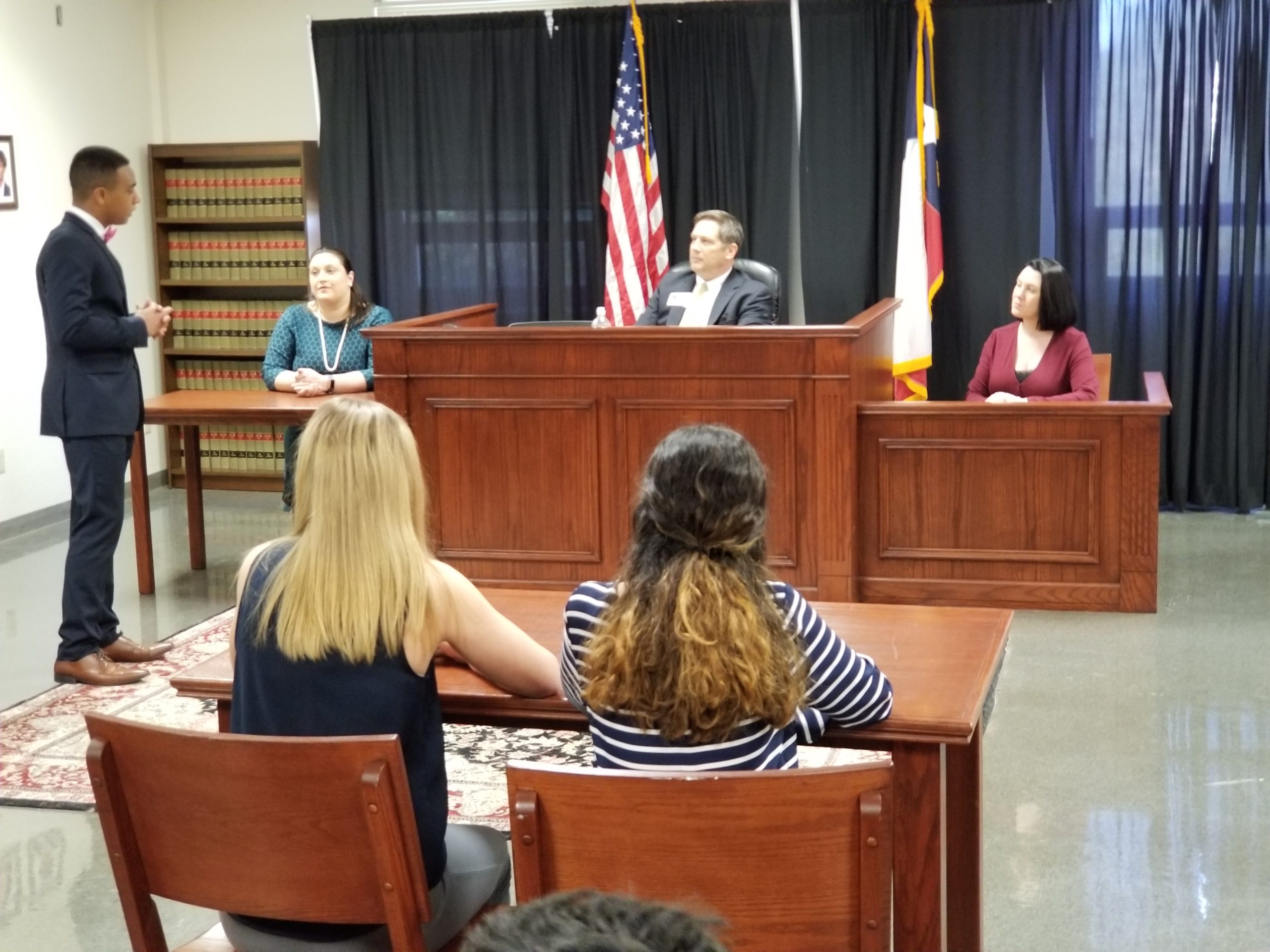
Devin Ritter, a junior at Akins High School in Austin, presents his opening statement to Texas Supreme Court Justice Jeffrey Boyd as attorneys and students observe.
When he was in law
school, Armin Salek noticed that most of his friends’ parents were also
attorneys. That didn’t make for a very diverse pool of people entering the
legal profession. To jump-start an interest in the law among young people who
hadn’t been exposed to that career path, Salek created the Legal Eagle
Internship at Austin’s Akins High School. It is the first high school legal aid
clinic in the country. Salek was awarded the 2020 Rather Prize, which recognizes of “the best idea to innovate
Texas education.” He plans to use the $10,000 he received to start more legal
clinics.
“We have the first cohort of high school students working on real,
legal cases – immigration, wills. Our students were particularly excited about
handling gender marker and name changes at the end of the year. … Through that
clinic, students at our school would be able to tell students who have not
identified with their name or gender marker that we support you, and we will
help you get the name identification that matches the way you see yourself.”
“What we are trying to do is create a pipeline for
underrepresented populations into the [legal] profession. Law should be a place
to advocate, regardless of where you start.”
“I really learned family
law through my students. They can tell you when a child can provide their
opinion for which parent they want to live with in a family law court. They’ll
tell you about situations where they were in immigration court, watching a
parent in deportation proceedings.”